
Indonesia's New TKDN Formula: Why Assembly Alone Is Not Enough
Indonesia changed its TKDN calculation framework in December 2025. Learn why local assembly alone may not deliver the TKDN score manufacturers expect and how supply chains, workforce, investment and R&D can affect localisation strategy.
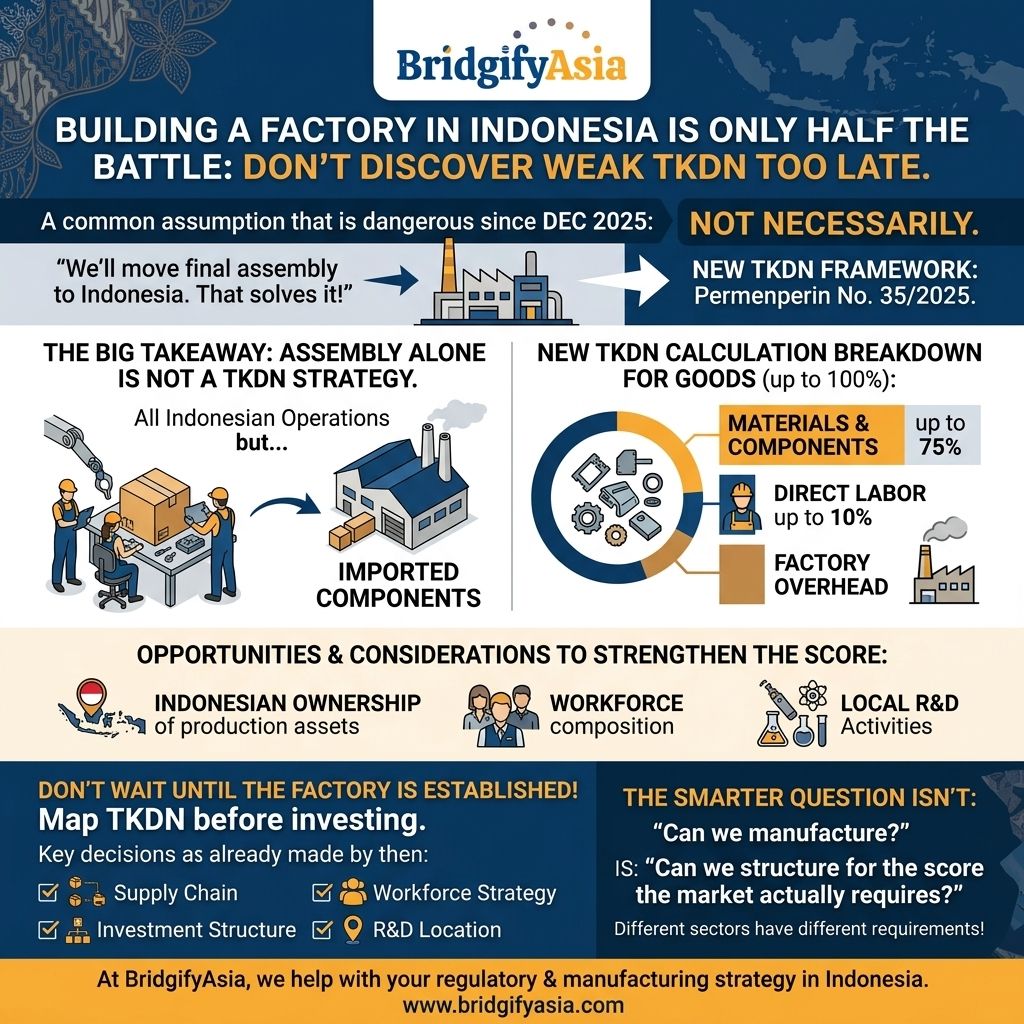
You can build a factory in Indonesia and still end up with a weak TKDN score.
That is the part many foreign manufacturers discover too late.
A common assumption is:
“We'll move final assembly to Indonesia. That should solve the TKDN problem.”
Not necessarily.
And since December 2025, that assumption has become even more dangerous to make.
Indonesia's Ministry of Industry introduced a new TKDN calculation framework under Permenperin No. 35/2025, changing how manufacturers need to think about local content.
The biggest takeaway?
Where your materials and components come from can matter far more than where the final assembly takes place.
Under the new framework for goods, materials and components can represent up to 75% of the TKDN calculation.
Direct labour accounts for up to 10%.
Factory overhead accounts for up to 15%.
So imagine this:
You assemble your product entirely in Indonesia.
You employ local workers.
You operate from an Indonesian factory.
But most of your components are still imported.
Your TKDN score may still fall short of what you expected.
Assembly alone is not a TKDN strategy.
But there is another side to the new framework that many manufacturers may find interesting.
Depending on how the business and investment structure meets the applicable requirements, Indonesian ownership of production assets and workforce composition can significantly influence the calculation. Local R&D activities may also create additional opportunities to strengthen the overall score.
This changes the conversation completely.
The best TKDN strategy may not simply be:
"How much can we assemble in Indonesia?"
The better question is:
"How should we structure our supply chain, investment, workforce and R&D in Indonesia to achieve the score we actually need?"
And that last part matters because there is no single TKDN target that applies to every product.
Different industries and product categories can face different requirements.
A score that works for one sector may not be sufficient for another.
That is why manufacturers should not treat TKDN as something to calculate after the factory has been established.
By then, some of the biggest decisions have already been made.
The factory location.
The component supply chain.
The investment structure.
The workforce strategy.
The R&D location.
All of these decisions can affect the outcome.
If you are planning manufacturing, assembly or localisation in Indonesia, the smarter approach is to map your TKDN strategy before committing to the investment.
Because the question is no longer simply:
"Can we manufacture in Indonesia?"
It's:
"Can we structure our Indonesian operations to achieve the TKDN score the market actually requires?"
At BridgifyAsia, we help international companies understand Indonesia's regulatory and market-entry landscape, including how TKDN considerations can affect manufacturing and localisation strategies.
Ready to Take Action?
Speak with our specialists about your specific regulatory requirements.
Book a Free Consultation