
Your Halal Certificate Is Like a Passport. It Doesn't Give You Automatic Entry to Every Country.
A version of this conversation comes up constantly with clients: "We're already halal certified, so we're covered for Indonesia and the Middle East." I have to explain why that's usually not true, and it tends to surprise people.
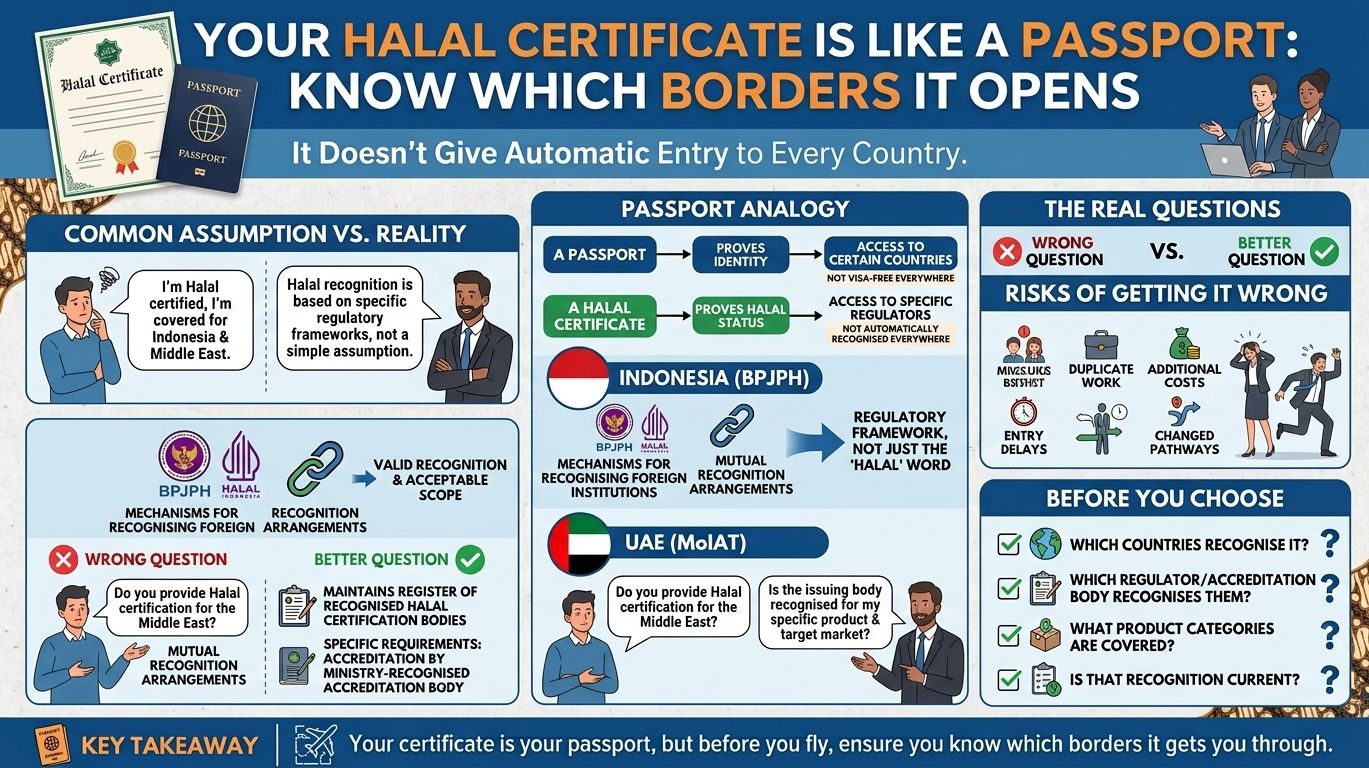
One of the most common assumptions I hear from manufacturers is:
"We're already halal certified, so we're covered for Indonesia and the Middle East."
It sounds reasonable.
But halal certification doesn't quite work that way.
Think of your halal certificate like a passport.
A passport proves who you are and gives you access to certain countries. But it doesn't automatically give you visa-free entry everywhere.
Halal certification works in a similar way.
A certificate issued by one halal certification body does not automatically mean that every other country, regulator or market will recognise it.
Indonesia is a good example.
BPJPH has specific mechanisms for recognising and registering halal certificates issued by foreign halal institutions, including arrangements based on mutual recognition. In other words, recognition is based on the relevant regulatory and institutional framework, not simply because a certificate says "Halal."
The UAE works on a similar principle.
Its Ministry of Industry and Advanced Technology (MoIAT) maintains a register of recognised halal certification bodies. Certification bodies seeking recognition must meet specific requirements, including having an accreditation certificate with an acceptable scope from an accreditation body recognised by the Ministry.
That means the real question isn't:
"Do you provide halal certification for the Middle East?"
The better question is:
"Is the certification body issuing my certificate recognised for my specific product and target market?"
Those are two very different questions.
Getting this wrong can mean duplicate certification work, additional costs, delays in market entry, or having to change your certification pathway after you've already started preparing for export.
So before choosing a halal certification body, don't just ask whether they can issue a halal certificate.
Ask:
Which countries recognise it?
Which regulator or accreditation body recognises the certification body?
What product categories are covered?
Is that recognition current?
Your halal certificate may be your passport.
But before you book the flight, make sure you know which borders that passport actually gets you through.
If you need to check whether your foreign certificate is recognized in Indonesia, our BPJPH Halal Certification service can help assess the applicable route.
Ready to Take Action?
Speak with our specialists about your specific regulatory requirements.
Book a Free Consultation