
Your Product Passed Every Test. Your SNI Application Still Got Rejected
Passing product testing isn't enough for SNI certification if your lab isn't accredited for that exact scope. A recent case involving 25 fortified rice brands shows how seriously Indonesia enforces SNI compliance, on accreditation and on products that simply don't meet the standard.
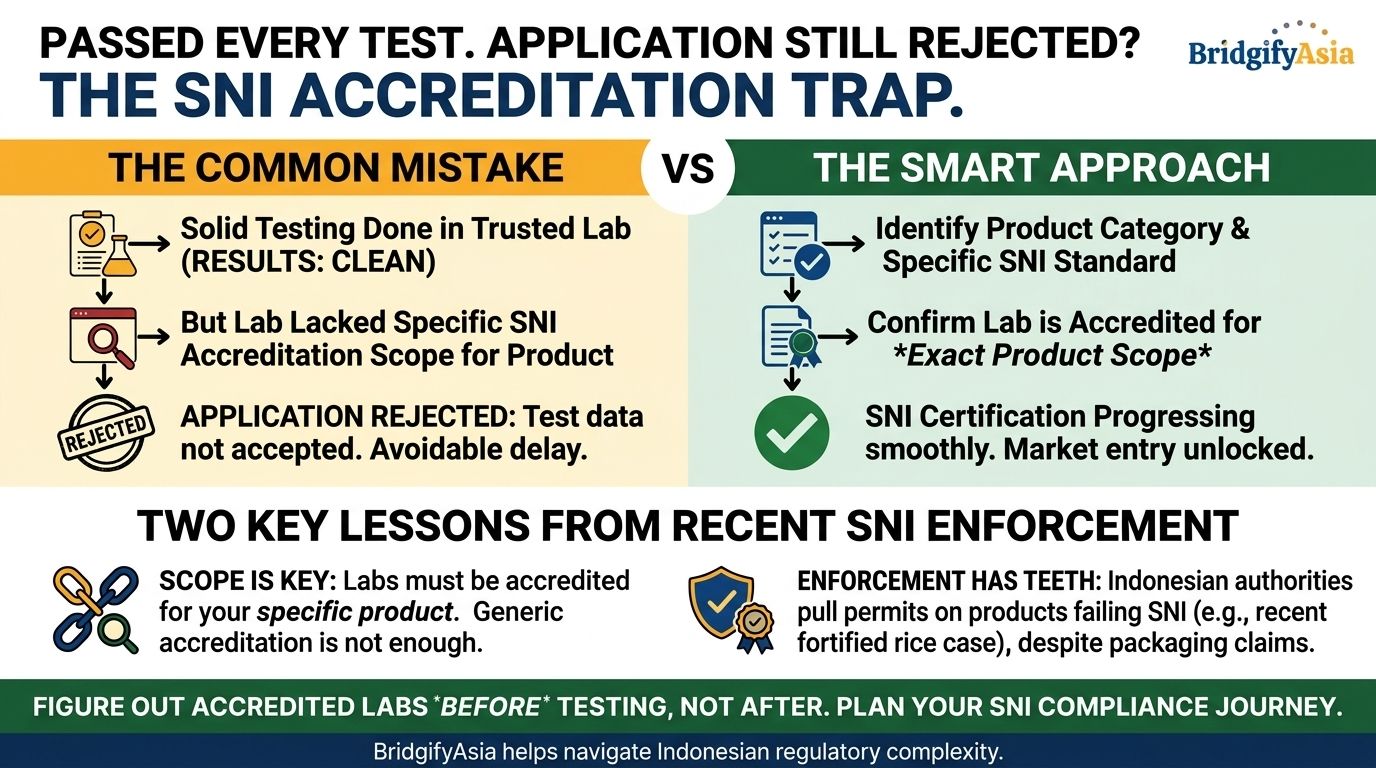
Picture this: you've run solid product testing through a lab you trust, results come back clean, and the SNI application still gets rejected. Not because the testing was wrong. Because the lab wasn't accredited for that specific scope.
That's a more common outcome than it should be.
Mandatory SNI certification typically requires testing through a lab accredited for the relevant scope, and certification through an accredited LSPro, a product certification body recognized under Indonesia's national accreditation system. Test data from a lab that isn't accredited for that specific scope, however rigorous the testing actually was, generally won't be accepted as part of an SNI application.
This isn't a bureaucratic technicality, and it's worth knowing SNI enforcement has real teeth on more than just accreditation scope. This week, Indonesian authorities pulled the permits on 25 fortified rice brands after lab testing found the products didn't actually meet SNI 9314:2024 and SNI 9372:2025 fortification standards, despite what the packaging claimed. That's a different failure mode from the one above, those labs were properly accredited, the products simply didn't perform, not an accreditation-scope mismatch. But the two stories share the same underlying lesson: Indonesia treats SNI testing as a real, enforced gate, whether the gap is in who did your testing or in what your product actually delivers. Some of those rice products were priced well above market rate on the strength of the fortification claim, and the case has since gone to Indonesia's food task force and attorney general's office. Worth flagging this one specifically came from two Indonesian news outlets covering the same government announcement, solid, but a single-event source rather than the kind of regulation-level citation the rest of this post rests on.
This catches manufacturers who assume a lab's general reputation is enough on its own. It isn't. Indonesia's SNI system is specifically strict about the chain of custody between the lab's accreditation scope and your exact product category.
Practical implication: figure out which accredited labs and LSPro bodies actually cover your product category before you commission any testing, not after. Retesting through the right accredited lab because the first round of results couldn't be used is a genuinely common and avoidable delay.
If you're a manufacturer outside Indonesia about to commission product testing for SNI, worth confirming your lab's accreditation actually covers this exact scope before you pay for it, not after. Has a testing partner's accreditation scope, rather than your actual test results, ever been the real reason an application got held up?
#SNI #Indonesia #ProductTesting #Accreditation #RegulatoryCompliance
Ready to Take Action?
Speak with our specialists about your specific regulatory requirements.
Book a Free Consultation